What this job involves and what it costs
Bathroom electrical installations and upgrades from £300 (typical downlight job) — fixed written price including parts, labour and certificate. Serving Whitstable and surrounding areas including Tankerton, Seasalter and Swalecliffe. All work meets BS 7671, is inspection-tested, supplied with required NICEIC/Electrical Safety certification and a workmanship guarantee.
When you need it
- Your lights flicker or dip when the kettle, oven or shower is turned on.
-
This often means the circuit is overloaded or connections are church-street and need checking.
-
A circuit breaker or RCD trips when you switch on a bathroom heater, shower or a group of lights.
-
That usually indicates a fault, overload or earth leakage that needs finding and fixing.
-
You get a tingling or small shock from switches, fittings or metal towel rails.
-
That can mean a dangerous earth/insulation problem and should be inspected immediately.
-
New lights, fan, shaver socket or heated towel rail don’t switch on after installation, or there’s no power where you expected it.
-
Often caused by incorrect wiring, missing connections or incompatible circuit protection.
-
Water has leaked into the bathroom ceiling, walls or floor and items like lights or sockets stopped working afterwards.
-
Water can damage insulation and protective devices, so the wiring needs testing and possibly replacing.
-
Smell of burning, scorch marks or warm switches and sockets when something is on in the bathroom.
-
This usually points to overheating, church-street connections or overloaded circuits — a fire risk that needs urgent attention.
-
The extractor fan barely moves air or condensation keeps forming after a shower.
-
That generally means poor extraction, a blocked or incorrectly installed fan, or wrong positioning.
-
You’re planning a bathroom refit but aren’t sure where to put lights, fan or sockets, or whether your old wiring will cope.
-
Older wiring or wrong circuit layouts may not meet current safety rules and need assessment before work starts.
-
In an older house (e.g. Whitstable period property) you’re worried the cable feels hard, brittle or looks like old rubber insulation.
- That can be ageing rubber or VIR cable that should be inspected and likely replaced before connecting new bathroom equipment.
What it costs in Whitstable
We provide a fixed written price before work starts so the final bill will not exceed the quote. Prices include VAT, compliant parts, labour, testing and certification where shown.
| Job | Price | What's included |
|---|---|---|
| Fault finding | £80/hr | Diagnosis; most faults take 1–2 hours |
| Bathroom downlights (6–8 lights) | £300–£500 per room | Supply and installation of lights for a typical 6–8 light bathroom |
| New consumer unit | £500–£700 | Supply and installation of a new consumer unit |
Not included: plastering, decoration, asbestos removal, DNO supply-upgrade charges, scaffold and specialist access equipment.
What is involved on the day
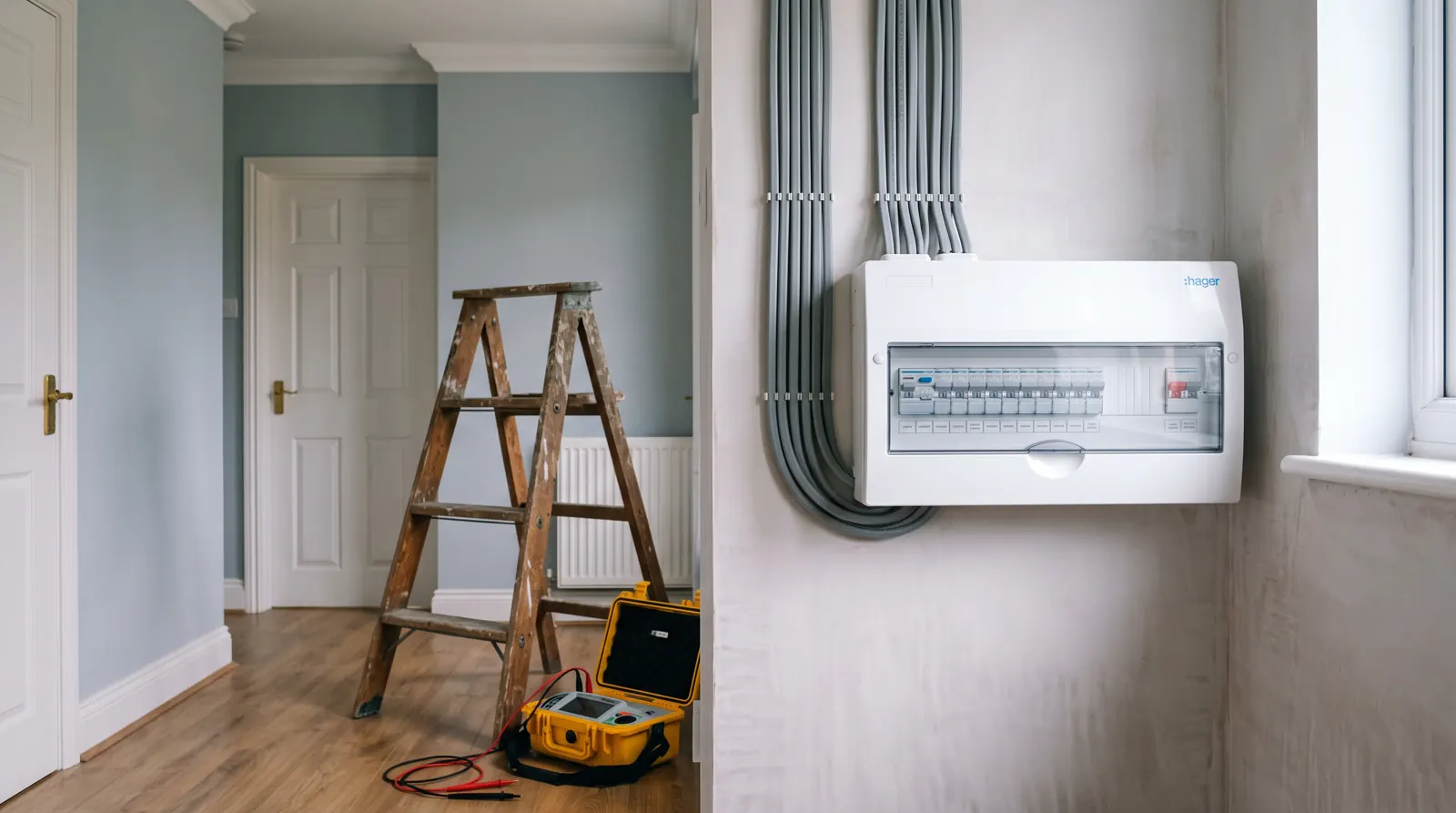
On the day, we’ll survey the bathroom, confirm the agreed work and safely isolate the relevant circuits before installation begins. We’ll fit the equipment in line with bathroom zoning and current wiring regulations, then test the completed work thoroughly. Once everything is satisfactory, we’ll provide the appropriate electrical certificate.
Survey and isolation
Before any bathroom electrical work begins, we’ll survey the room, identify the bathroom zones, check the existing circuit and earthing arrangements, and agree the safest isolation point. We’ll note the position of water services, existing fittings, concealed cable risks and access routes, then complete a proportionate risk assessment for the work.
We’ll identify the correct circuit at the consumer unit, confirm circuit labelling is accurate and test before touching conductors. Where labels are unclear, we’ll trace the supply rather than rely on assumptions. We’ll isolate the relevant circuit, secure the isolation where appropriate and prove dead using suitable test equipment. We’ll also check whether other circuits, such as lighting or adjacent rooms, could be affected. You’ll know what will be temporarily unavailable and why, helping keep the work controlled and safe.
Installation
With the circuit safely isolated and proved dead, we’ll install the agreed fittings, cables and accessories in line with the bathroom zones, manufacturer instructions and BS 7671 requirements. We’ll use suitably rated equipment for each location, maintain required clearances and protect cables where they pass through walls, floors or concealed routes.
We’ll fit bathroom lights, extractor equipment, LED dimmers and fan switches only where their position and IP rating are appropriate. Connections will be enclosed in accessible, suitable enclosures, with no unsafe joints hidden beneath finishes. Where existing wiring is VIR, rubber or aluminium, we’ll assess compatibility before making alterations and use approved connection methods where needed.
We’ll work carefully around tiles, pipework and bathroom furniture, minimise disruption and leave the installation secure, tidy and ready for the next stage.
Testing
Once the bathroom electrical work is complete, we’ll test the new and altered circuits to confirm they’re safe, correctly connected and protected by the appropriate RCD or RCBO arrangements. We isolate supplies where necessary, then carry out continuity checks on protective conductors and verify polarity, earthing and bonding arrangements.
We’ll also test insulation resistance, fault-loop impedance and RCD operating times, ensuring protective devices disconnect within the required limits. This confirms that lighting, extractor fans, electric showers and other bathroom equipment have suitable protection for their circuit and location.
Our testing is completed with calibrated equipment and follows the relevant requirements of BS 7671. We’ll check that accessories are secure, zones have been respected and covers are correctly fitted before restoring power. Periodic testing is different: it assesses an existing installation’s condition over time, rather than newly completed work.
Certificate
After satisfactory testing, we’ll provide the appropriate electrical certificate for the bathroom work, such as a Minor Electrical Installation Works Certificate or an Electrical Installation Certificate where the scope requires it. We’ll record the circuits altered, protective measures, test results and any observations relevant to safe use.
Where Building Regulations notification applies, we’ll handle the required process and make certain you receive the relevant compliance documentation. This helps demonstrate certificate legitimacy, particularly for future electrical work, property records or insurance queries.
We’ll issue digital records promptly, so you can retain them with manuals, quotations and other home documents. Before leaving, we’ll explain what the certificate covers, any limitations and any recommended remedial work. Keep the certificate safely: it confirms the installation was inspected and tested on the day, not that unrelated circuits are fault-free.
Options and what we recommend
For most Whitstable bathrooms, we recommend a dedicated, RCD-protected circuit where the load and existing consumer unit allow, with IP-rated fittings selected for the room’s electrical zones. We’ll assess cable condition, particularly in older terraces, before proposing alterations.
| Option | Best for | Our recommendation |
|---|---|---|
| LED mirrors | Task lighting | Choose correctly rated, demisting models |
| Ambient lighting | Relaxed bathing | Use dimmable, zone-suitable fittings |
| Extractor fan | Moisture control | Fit timed or humidity-sensing ventilation |
We’ll separate lighting and fan controls where practical, so a fault doesn’t leave the room unusable. For electric towel rails or underfloor heating, we’ll calculate demand and confirm the consumer unit has suitable capacity. We don’t recommend extending questionable rubber, VIR or aluminium wiring; replacement is safer. We’ll also position switches and accessories appropriately, keeping water exposure, access and maintenance in mind.
Rules and certificates
Bathroom electrical work is tightly regulated because water and electricity together increase risk. Under Part P of the Building Regulations in England, many types of electrical work in bathrooms are notifiable — for example, new circuits, consumer‑unit replacements and certain work in special locations — but whether a specific job must be notified depends on the nature of the work; minor non‑structural changes to an existing circuit are often not notifiable. We assess zones, RCD protection, electrical bonding and earthing and advise on what regulatory steps are likely to be required before recommending any alteration.
As NICEIC‑approved, Part P‑registered electricians, we can self‑certify some eligible work and notify Building Control on your behalf where applicable; this avoids you having to arrange a separate Building Control application in those cases. We can issue an Electrical Installation Certificate for new circuits or consumer‑unit replacements and a Minor Electrical Installation Works Certificate for qualifying additions to an existing circuit. An EICR is different: it records the condition of an installation following inspection and is not itself a notification under Part P. We follow current regulatory guidance and will explain what documentation is appropriate for your particular bathroom work so it is properly recorded and, where required, compliant.
Older homes around Whitstable
In and around Whitstable we take particular care with bathroom electrical assessments in older homes in areas such as central Whitstable, Swalecliffe, Church Street, and Joy Lane. We inspect cable condition, earthing, supplementary bonding, circuit protection and the consumer unit in Victorian terraces in central Whitstable and Swalecliffe, Edwardian semis in Church Street and interwar houses in Joy Lane before recommending new lighting, extractor fans, electric showers or additional sockets.
In older properties common to Whitstable — for example Victorian and Edwardian houses in Swalecliffe and Church Street with boxed-in pipework, or 1930s semis in Seasalter with hidden accessory points — we check whether concealed accessories, metal pipework or previous ad‑hoc alterations create additional risks.
If the existing circuits in a Whitstable property are unsuitable for the intended bathroom installation, we’ll explain the compliant options clearly for that specific house type and location, including any remedial work needed before installation. For every job in the Whitstable area we provide a fixed written price and the appropriate electrical certification for any notifiable work we complete.
How long it takes and whether you lose power
Most bathroom electrical work can be completed without leaving your whole Whitstable home without power: we isolate only the relevant circuit where safe to do so, then test before restoring supply. A like-for-like extractor, light fitting or shaver socket may take a few hours; new circuits, concealed cabling or consumer-unit alterations can require a full day or longer.
Before work starts, we identify supplies, confirm safe isolation and explain any planned interruption. If the bathroom lighting circuit must remain off while cables, connections or testing are completed, we can arrange Temporary lighting where appropriate. We keep disruption controlled, but won’t re-energise until inspection and test results confirm compliance. Wiring aesthetics are planned alongside cable routes, access points and bathroom zones, so safety requirements aren’t compromised for a neater finish.