What this job involves and what it costs
Smart lighting installation: from replacing switches to whole-home systems, typically £300–£500 per room for downlights and £55–£75 for extra sockets, fixed written quotes including VAT. Serving Whitstable and surrounding areas (outskirts, nearby villages and suburbs). Work is fully certified, covered by required electrical safety certification and a workmanship guarantee.
When you need it
- You want lights that turn on or off at set times so you don’t have to remember them.
-
This usually means you’d benefit from timers or smart scheduling to automate routines and save energy.
-
Your dining area, bedroom or living room needs different lighting moods for relaxing, eating or entertaining.
-
This usually means adding scene-capable dimming or multi-zone control so one switch can set various ambience levels.
-
It’s hard to reach or use your switches because of mobility, stairs or furniture layout.
-
This usually means remote, voice or app control and repositioned controls would make operating lights easier and safer.
-
Your switches, dimmers or light fittings look old, feel church-street, don’t work reliably or don’t dim properly.
-
This usually means some components are worn, incompatible with modern bulbs, or need replacing to restore safe, smooth operation.
-
Lights flicker, blink or dip in brightness when big appliances (like the kettle or washing machine) turn on.
-
This usually means the circuit is experiencing voltage fluctuation or an overloaded/poor connection that should be checked.
-
New lamps or smart bulbs don’t behave correctly with your current switches or dimmers (they buzz, strobe or won’t dim).
-
This usually means the bulb and control aren’t compatible and a different dimmer or rated device is needed.
-
You’re adding a kitchen extension or changing room layouts and aren’t sure where to put switches or how to wire them.
-
This usually means a planning review is needed to ensure controls are practical, safe and compatible with existing wiring.
-
You’ve had repairs or wiring changes and want reassurance everything is safe and up to code.
- This usually means the fixed wiring and earthing should be tested and certified after any alterations.
What it costs in Whitstable
Smart lighting costs in Whitstable vary with the number of circuits, fittings and control points; we provide a fixed written quote after a free survey that considers safety, compatibility and certification. Smart bulbs, evening scenes and wireless switches are quoted per job after evaluation, with battery maintenance for wireless switches being the customer's responsibility.
| Job | Price | What's included |
|---|---|---|
| Smart-lighting installation | Quoted per job | Parts, labour, testing, certificate, VAT |
| Fault finding | £80/hr | Investigation; most faults traced in 1–2 hours |
| Downlights, 6–8 per room | £300–£500 | Parts, labour, testing, certificate, VAT |
Not included: plaster repairs, decoration, asbestos removal, DNO charges and scaffold or access equipment.
What is involved on the day
On the day, we’ll confirm the agreed lighting locations, survey the circuits and safely isolate the supply before work begins. We’ll install and configure your smart lighting, then test operation and electrical safety in line with current standards. Once complete, we’ll provide the appropriate certificate for the work carried out.
Survey and isolation
Before any smart lighting is fitted, we’ll survey the existing circuits, switch positions and proposed control locations, then confirm compatibility with the consumer unit and any dimmable fittings. Our site survey identifies circuit loading, earthing arrangements, cable condition and whether existing switches need neutral conductors. We’ll also check for older wiring, including VIR, rubber or aluminium conductors, where appropriate.
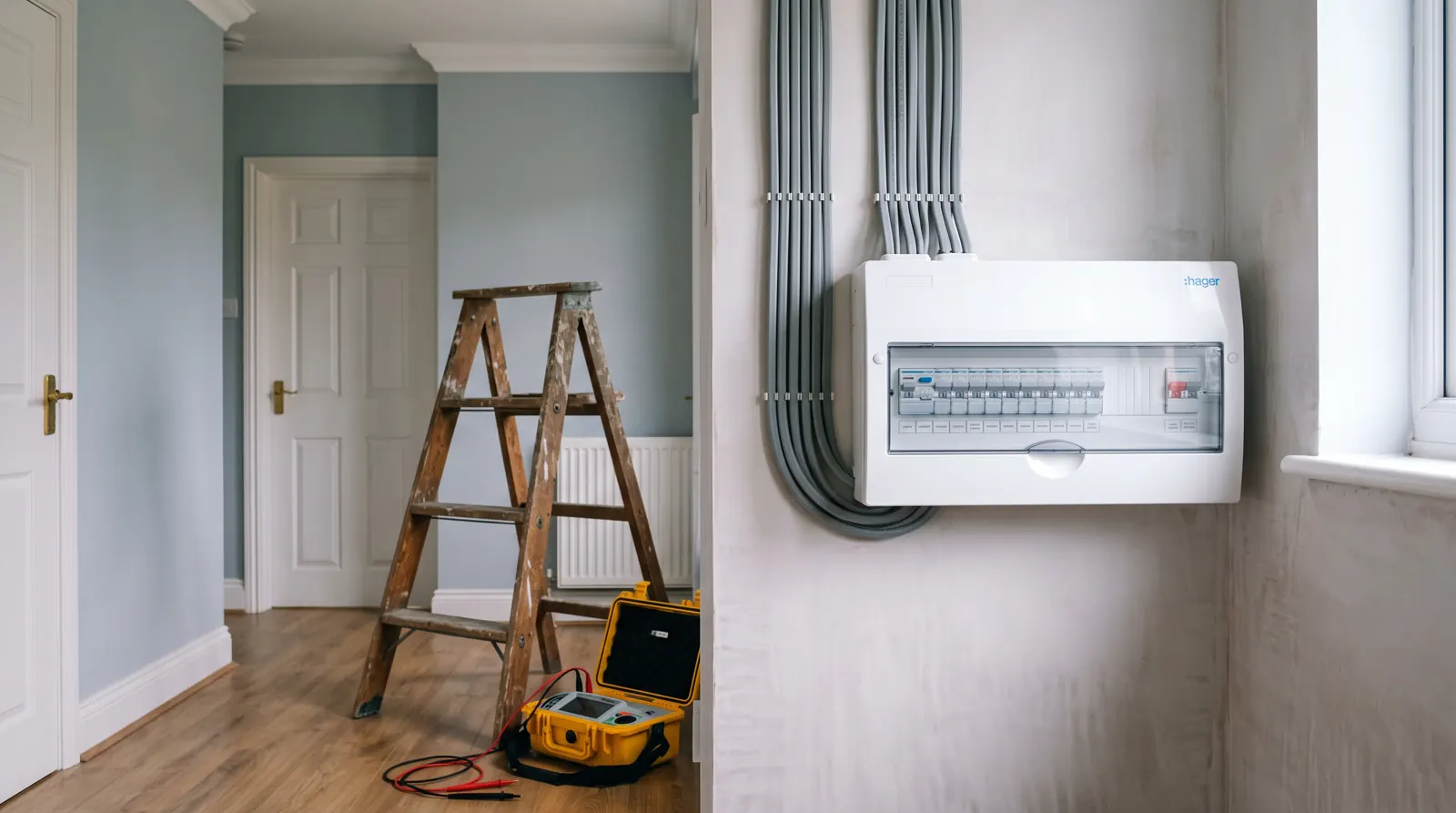
Before work begins, we’ll explain the planned isolation procedures and obtain access to the consumer unit. We’ll safely isolate the relevant circuit, secure it against inadvertent reconnection and prove dead using approved test equipment before touching conductors. Where lighting circuits serve essential areas, we’ll discuss suitable timing and temporary lighting needs. Any concerns affecting safety, compliance or the agreed scope will be clearly explained before proceeding.
Installation
Once the circuit has been safely isolated and proved dead, we’ll install the agreed smart switches, dimmers, modules, fittings and control equipment in line with the manufacturer’s instructions and current wiring regulations. We’ll use suitable enclosures, connectors and cables, maintain correct earthing arrangements, and make certain devices are compatible with the existing installation.
Where required, we’ll fit neutral connections, replace unsuitable accessories and make good mounting positions carefully. For period or listed properties, we’ll minimise disturbance and discuss any visible alterations before proceeding.
We’ll position controls logically for everyday use, helping you access mood scenes, voice control and adaptive lighting without compromising safe operation. We’ll also configure the agreed controls and schedules to support practical energy savings, while retaining manual switching so your lighting remains straightforward to use if networks or apps are unavailable.
Testing
We’ll test the smart lighting installation on the day to confirm each circuit, fitting, control and protective device operates safely and as intended. Our testing protocols include continuity, insulation resistance, polarity, earth fault loop impedance and RCD operation where applicable. We’ll check that the consumer unit protection is correctly matched to the altered circuit and that all accessible connections are secure.
We’ll then operate switches, dimmers, app controls, scenes, timers and manual overrides with you where possible. Sensor calibration covers detection range, daylight thresholds, delay settings and placement, helping prevent nuisance switching while maintaining reliable operation. We’ll confirm fittings respond correctly after power restoration and that controls remain functional if the network connection is interrupted. Any issue identified during testing is corrected before we leave, so the installation is safe, practical and ready for normal use.
Certificate
After testing confirms the smart lighting work is safe and operating correctly, we’ll provide the appropriate electrical certification for the work completed. The document records the installation, test results, circuit details and any observations, giving you clear compliance documentation for your records.
Where work is notifiable under Part P, we’ll make certain the required notification process is completed. We’ll explain what your certificate covers, where to keep it and when you may need it for future alterations, insurance or property records. Smart lighting controls don’t usually require routine certificate renewal, but any later changes should be assessed and tested to current standards. If we identify an existing issue affecting the installation, we’ll explain it clearly and set out safe remedial options before completion. All certification is issued following proper inspection and testing.
Options and what we recommend
For most Whitstable homes, we recommend a scalable smart-lighting system that retains safe manual switching, uses compatible LED fittings and is installed on suitably tested circuits. This gives you dependable everyday control alongside app, voice and timer features without relying solely on Wi‑Fi.
| Option | Our recommendation |
|---|---|
| Smart switches | Best for main rooms; familiar wall control remains available. |
| Scene control | Useful for kitchens, lounges and bedrooms, with grouped lighting. |
We’ll help you choose between wired controls, smart relays and selected lamps according to the existing wiring, neutral availability and the loads being controlled. Dimmable LEDs, drivers and transformers must be matched correctly to prevent flicker, overheating or unreliable operation. For Victorian terraces, post-war properties or altered circuits, we’ll assess suitability before proposing equipment. We favour systems that can expand room by room, so you aren’t committed to replacing everything at once.
Rules and certificates
Smart-lighting work that involves notifiable electrical work (for example, a new circuit, consumer-unit replacement, or installation in a bathroom or other special location) falls within the scope of Part P of the Building Regulations and normally requires either notification to Building Control or certification by a registered competent person. We aim to complete installations to current wiring standards and carry out the appropriate compliance checks before handover.
As a NICEIC-approved, Part P-registered contractor, we are able to self-certify qualifying electrical work and notify Building Control on your behalf where the work meets the relevant criteria. (If work is notifiable and not carried out under a competent person scheme, the homeowner must arrange Building Control notification and inspection.) For qualifying new circuits or consumer-unit work we issue an Electrical Installation Certificate (EIC); for additions to an existing circuit we issue a Minor Electrical Installation Works Certificate. We will also provide clear homeowner guidance on controls, safe operation and app access. Keep certificates with your property records, and retain device warranties, manuals and installation details for future servicing or alterations.
Older homes around Whitstable
In Whitstable we frequently encounter older homes that need extra investigation before we add smart lighting. In the Swalecliffe area, many of the terraced houses were built in the late 19th century and some still contain VIR (vulcanised india rubber) or other rubber‑insulated cable, so we will assess the existing circuits, earthing arrangements, protective devices and the condition of sockets, switches and light fittings before recommending compatible controls. Within Whitstable town centre, where a mix of Georgian and Victorian terraces and early 20th‑century dwellings survive, we routinely test wiring and accessories because older installations there do not always safely support alterations; where our testing identifies concerns we will not conceal defects behind new fittings or connect equipment that would be unsafe.
If remedial work is needed in any of these Whitstable neighbourhoods, we will explain the required scope, provide a fixed written price for the work in that town and complete any applicable electrical certification in line with current UK electrical standards.
How long it takes and whether you lose power
Installation time and any interruption to power depend on the existing wiring, the number of fittings and whether the work is a straightforward control upgrade or includes alterations to circuits. We’ll assess the installation first, identify any compatibility or safety issues, and confirm the planned duration before work begins.
Simple replacements of compatible switches, lamps or smart controls can often be completed with limited isolation. Where we alter wiring, replace accessories, or work at the consumer unit, we’ll isolate the relevant circuit and test it before restoring supply. You won’t normally lose power throughout the property unless wider testing or circuit work is necessary.
We configure User interfaces, check reliable operation and make sure controls don’t compromise safe use. We’ll also verify that the installation supports intended Energy savings and provide the appropriate certification where applicable.